

Sofia Batalha
Eco-Mythologist
Writer
(Un)Educator
Cultivating a caring and ethical practice grounded in sensitive listening, ecological co-regulation, and radical implication with life.
I do not offer quick solutions or universal recipes. But I invite us into the territory of paradox, grief, wild beauty, and loving responsibility toward the world.
ꉓꂦꌗꂵꀤꉓ-ꉓꃅ꓄ꃅꂦꈤꀤꉓ ꉓꍏꋪ꓄ꂦꁅꋪꍏꉣꃅꀤꍟꌗ
Between earthly pedagogies and mythical imaginaries, I cultivate an unruly ethic of belonging and listening, where there are no formulas for healing, but a loving stubbornness in sustaining the unfinished, the paradoxical, the sacred, and the entangled.
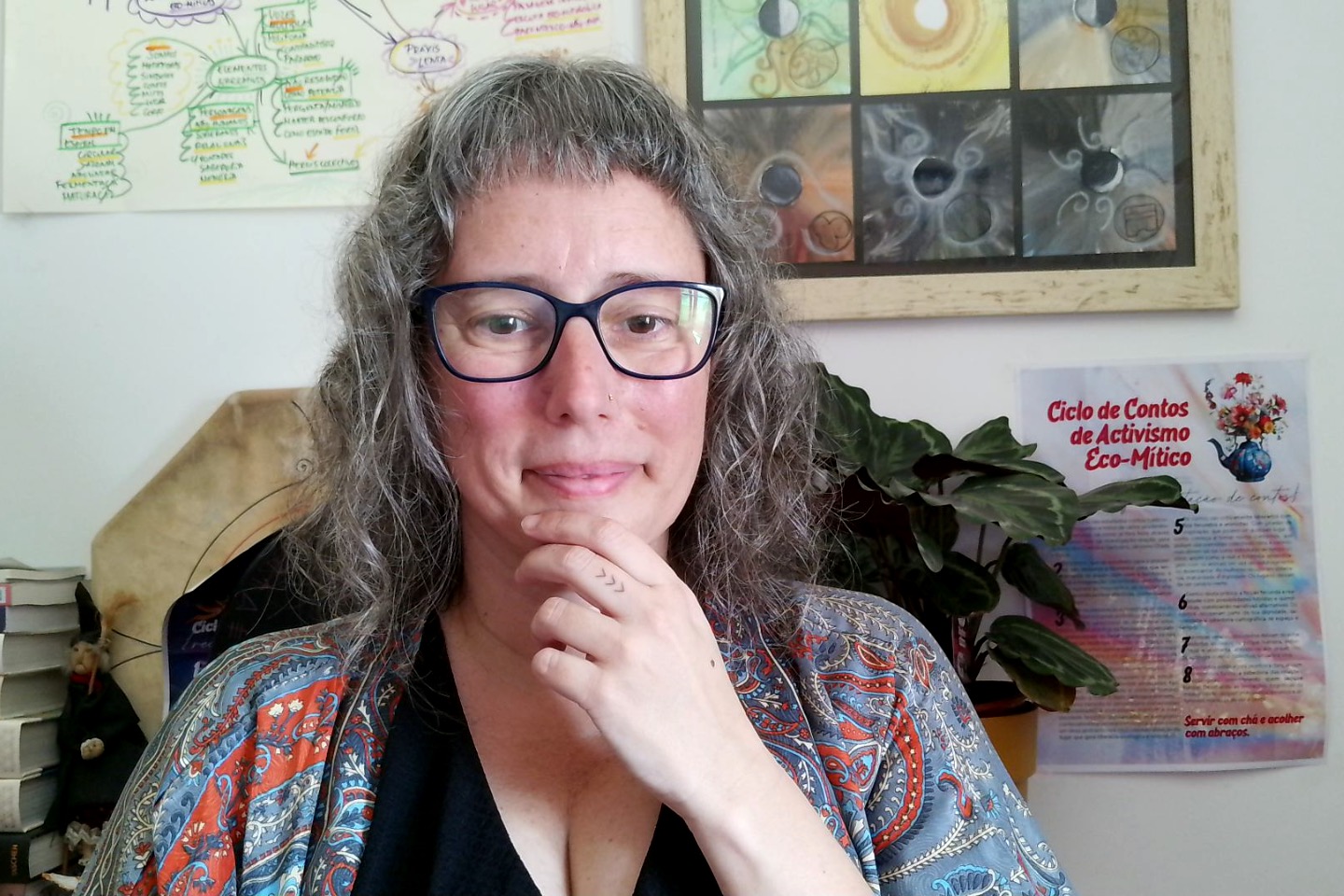
Hello, I'm Sofia and I'm the research-artist-writer behind ꉓꂦꌗꂵꀤꉓ-ꉓꃅ꓄ꃅꂦꈤꀤꉓ ꉓꍏꋪ꓄ꂦꁅꋪꍏꉣꃅꀤꍟꌗ on Substack
Ecologies of Myth, Memory, and Grief
This project is not a platform for answers. It is a living terrain of questions, mythopoetic textures, and eco-mythological offerings.
Here we walk alongside primal mysteries, subterranean ancestral revelations, interwoven ecological narratives, dreams, and practices of bodily listening that emerge from the personal and collective wounds of modern separation.
We are not here to extract meaning, but to be soiled and transformed by what we do not yet know.
The stories and articles shared arise from the tangled roots of dreams, research, mourning, and a long process of unlearning the colonial, modern, and disembodied patterns that have tamed not only our lands but also our imagination. Nothing here has academic authority or “mystical certification”.
This is an ongoing, situated, and responsible investigation that emerges from the wounded landscapes of the Global North, as an attempt to remember what it might mean to become capable once again of responding, embracing paradox, weeping, caring, and listening.
Eco-Myths
We Were Never Separate From the Living World
Through myth, ecological memory and speculative storytelling, we unsettle inherited narratives of separation and recover ways of imagining, feeling and participating in a living Earth.
Activism of Perception
Questioning the inherited stories that make separation, domination and extraction appear natural or inevitable.
Rewilding Myth & Imagination
Composting old tales and their hierarchies, allowing places, creatures and silenced relations to regain agency.
Ecological Kinship & Responsibility
Remembering that we already belong to living webs of reciprocity, where care becomes participation rather than control.
The Work
Writing
Articles and tales stemming from classes and lectures, imagination, dreams, and place. Following the lines of decolonial Ecopsychology, Eco-Mythology, and Ecofeminism.
Eco-Mythic Tales
The Eco-Mythological Tale is a symbiotic praxis that functions as a living body of listening, of sensitive memory, and of reconnection with the web of life.
I write amid revolution and upheaval, between anger and grief. But I also write out of reverence for the ground that welcomes and sustains me.
(Un)Learning Eco-Mythic Trails
The sessions I offer here are not classes, consultations, or solution packages. They are living encounters, places of listening, presence, and co-meaning, where we can open up questions, feel the body, let go of certainties, or simply be with what is.
Eco-Therapeutic Witnessing
These are 1:1 sessions for those who feel the multiple crises of the world in their bodies and hearts; a revolutionary act of returning affection and fascination to the living territory that has always sustained us.
Eco-Mythic Activism
Eco-Myth is a slow and unraveling storytelling pedagogy, anchored in refusal and an ethics of relation, unsettling the desire to adopt or control.

ECO-MYTHIC PRAXIS & PARTICIPATION
Reimagining How We Inhabit the Living World
Our ecological crises are also crises of perception, imagination, and relationship. The stories we inherit shape what we believe is possible, whose lives matter, and how we participate in the world.
Through eco-mythic activism, writing, learning spaces, and collective inquiry, I invite us to challenge narratives of separation, domination, and extraction, while nurturing situated practices of reciprocity, care, and ecological responsibility.
FAQ
Questions at the Threshold
Not everything needs a definitive answer. Some questions are doorways into deeper inquiry.
Here are a few starting points for understanding my eco-mythical work, its ethical commitments, and the different ways we might learn, imagine, and participate together.
What is Eco-Mythology?
Eco-mythology explores the living relationships between stories, bodies, places, ecologies, and cultural imagination. Rather than treating myths as universal psychological symbols or relics of the past, it approaches them as situated, evolving narratives that shape how we perceive and participate in the world. It asks what our stories have taught us to remember, forget, fear, dominate, or love.
What is Eco-Mythic Activism?
Eco-mythic activism is a form of literary, affective, and perceptual activism. Through storytelling, critical inquiry, and speculative fabulation, it challenges the inherited narratives that normalize separation, extraction, coloniality, and human superiority. It does not replace direct political or ecological action. It works alongside them, questioning the cultural imagination through which action becomes possible.
Is Eco-Mythology a spiritual practice?
Not necessarily. Myth, ritual, and ecological relationships can have profound spiritual dimensions, but eco-mythology is not a universal spiritual system or a collection of sacred experiences for individual consumption. My approach is grounded in ecological literacy, historical accountability, cultural context, and the living relationships of particular places. Enchantment is not an escape from material reality.
Is this a form of therapy or personal development?
Eco-mythology is not a self-improvement programme, nor does it promise healing, empowerment, or personal transformation. Although my work engages with ecopsychology, grief, embodiment, and relational practices, its emphasis is not on optimizing the individual. It invites us to reconsider the ecological, cultural, political, and collective relationships in which our lives unfold. Educational and mythic offerings should not be confused with clinical mental healthcare.
Is Eco-Mythology a political and collective practice?
Yes. Eco-mythology is inherently political because stories are never innocent or separate from the material world. They shape whose voices are heard, whose bodies are controlled, whose knowledge is legitimized, and which relationships with the Earth become imaginable or disposable.
Eco-mythic activism questions the colonial, patriarchal, anthropocentric, and extractivist narratives that continue to organize our societies. It is not simply about interpreting myths differently, but about unsettling the cultural assumptions that normalize domination, separation, and ecological violence.
And it is necessarily collective. No story belongs to an isolated imagination, just as no transformation happens outside the relationships that sustain and implicate us. Eco-mythology cultivates shared inquiry, ecological accountability, and more-than-human kinship, recognizing that changing how we perceive the world also changes how we might participate in it.
It does not replace direct political action. It works alongside it, tending to the cultural imagination from which our actions, resistances, and possibilities emerge.
What does a decolonial approach to mythology mean?
It means recognising that stories are never outside history or power. Many inherited narratives carry colonial, patriarchal, racist, and anthropocentric structures. Rather than romanticising ancestral traditions, we can examine these inheritances critically while learning from living, situated knowledge traditions without claiming ownership of them. This work requires humility, accountability, and an awareness of my own position within European colonial histories.
What do you mean by relational responsibility?
Responsibility is not simply an individual obligation to behave better. It is the ongoing capacity to respond to the relationships that sustain and implicate us: land, water, human and more-than-human communities, histories, and future generations. It asks us to move beyond consuming experiences of nature towards situated participation, reciprocity, and care.
Why are grief, discomfort, and uncertainty important in your work?
Because ecological and cultural transformation cannot always be approached through optimism, solutions, or reassurance. Grief can reveal relationships that have been wounded or interrupted. Discomfort may expose inherited assumptions. Uncertainty can create room for questions we have not yet learned to ask. These experiences are not romanticized or demanded; they are approached with attention, care, and respect for different capacities.
What is Eco-Mythology for? Why cultivate shapeshifting capacities?
We live in a time when many of our inherited ways of thinking, knowing, producing, belonging, and organizing life are revealing their limitations, even as we remain deeply dependent on them. We know something must change, yet not every transformation frees us from what we seek to overcome. We want to care, but carry habits of control. We long for community, but have been educated into separation.
Eco-mythology might help us cultivate individual and collective capacities for shapeshifting: not as personal reinvention, adaptation, or self-optimization, but as the difficult, ongoing practice of changing how we perceive, relate, imagine, and respond to the living world.
Through stories, critical inquiry, embodied practices, and ecological listening, we learn to recognize what needs to be composted before something else can emerge.These are not skills to master or virtues to acquire. They are relational, ethical, and ecological postures that can be cultivated together, through the rhythms and responsibilities of actual places and communities.
The purpose is not to become more conscious, resilient, or evolved individuals, but to widen our collective capacity to respond to life’s complexity without reducing it to our need for control, salvation, or innocence.
Eco-mythology does not promise a destination. It helps us cultivate the ground on which different ways of living together might become possible.
Do I need to know anything about mythology or ecology to participate?
No previous knowledge is required for introductory offerings. Curiosity, openness to questioning familiar assumptions, and a willingness to encounter complexity are valuable starting points. Some courses and research-based gatherings involve more demanding theoretical work, and their descriptions will explain what to expect.
How can I engage with your work?
You can begin with my essays, books, and eco-mythical tales, or explore courses, workshops, shared inquiry, and collaborative projects when available. Different encounters offer different degrees of participation, from reading and contemplation to collective ecological learning. The invitation is not to adopt a fixed worldview, but to enter a thoughtful, situated conversation.
Can we collaborate on a workshop, educational programe, or research project?
Yes. I welcome enquiries about collaborations that resonate with eco-mythology, ecopsychology, relational education, ecological grief, cultural regeneration, and critical storytelling. Each possibility is considered in relation to its specific context, ethical commitments, available resources, and mutual responsibilities.
Sofia Batalha
Eco-Mythic-Activism, eco-mythology, ecopsychology, art and books. No fear of paradox, anti-fascist. Curious on the spectrum of cynicism.